Helping out to make a greener earth

Saturday, January 1, 2011

Five Airports in 2 Weeks

Due to some unexpected turn of events, I found myself passing through five different airports over a span of two weeks (October 8 to 23). Given the very short interval between airports, I decided that it would be interesting to see how these five airports compare in terms of approach to indoor landscaping and plant utilization.

I have been meaning to start working on this post since I arrived from Bangkok more than two months ago but  have not been able to.  Since one of the main reasons that has prevented me from taking on the task is the length of the write up, I have decided to divide it into several installments.

There will be a total of five parts broken down as follows:

a.   Philippines - Ninoy Aquino International Airport

b.  Taiwan - Taoyuan International Airport

c.  Singapore - Changi International Airport

d.  Indonesia - Juanda International Airport

e.  Thailand - Suvarnabhumi International Airport

First Stop, the Ninoy Aquino International Airport (Manila, Philippines)

The Ninoy Aquino International Airport (NAIA) is made up of three terminals.  Terminal 1 is for all international carriers other than Philippine Air Lines (PAL) and Cebu Pacific. Terminal 2 is for PAL while Terminal 3 is for Cebu Pacific.

The first leg of my journey started with NAIA's Terminal 2 as I was taking PAL for my flight to Taipei.

Terminal 2 is a modern facility and is a great improvement from Terminal 1 which has always served as the international airport since I can remember (1970's).  It is made of steel and glass and offers wide open views of the landing field and the open areas that make up the airport.

Entrance to the airport is quite straightforward and the landscaping is very functional and institutional in character though a bit indistinct.  Just before entering the check-in area, several spaces on the second floor have been converted into outdoor pocket gardens.  Palms, irises, sansevieras, plumerias, ficus benjamina, essentially make up this generic composition.  The turf is decently maintained but the other shrubs can stand a bit of tidying up.

On another side one can see this water feature which rather than adding to the overall appeal of the pond on which it stands calls too much attention to how poorly conceptualized and executed an otherwise interesting concept.  It does not help that the nautilus inspired water feature is sloppily maintained with brown algae growing completely on its inner walls but the sorry excuse for a vertical garden made up of struggling asparagus ferns grown of soft polybags.


Just before entering the check-in counter area, passengers will pass by aisles with a few planters like the one on the right.  Plant selection is correct given the conditions in the area:  a palm for height with aglaonemas and bromeliads for the base is a proven fomula.  

Unfortunately, the plants are worn out and needs to be replaced already.  It really is a shame because given the lighting and temperature conditions, these plants should do quite well, except maybe the bromeliads.  

The most likely culprit:  poor growing medium, inadequate feeding and/or watering program or poor plant quality at planting time.


After checking-in, one must spend some time in the waiting area before boarding. Just like most airports, there are the usual duty free shops to entice bored or anxious passengers, restaurants/coffee shops where one can grab a bite just in case food will not be served on board.  And of course, the plants or interior landscape arrangements to give the space a more natural feel.

There are a number of spaces in the waiting area that has been designated by the designers for plants. It is easily discerned that the designers set aside these spaces to showcase the beautiful plants that are readily available in a tropical country like the Philippines.  Add to this the creativity of filipino garden designers and landscapers.

 Below are the planting arrangements that have been done on some of these spaces.


The composition above is made up of zamioculcas, guzmanias, tillandsias, and sanseverias.  It has weathered tree trunks for the vertical element, with several boulders and loose stones for additional non-plant interest.  And one could not miss the imitation japanese lantern which seems to be completely out of place plus the colorful bromeliad flowers made out of plastic. At first glance, the flowers seem real.  
Sometimes, one's knowledge can be disadvantageous...... 


The arrangement above has definitely seen better times.  The plant selection is generally good and that can be seen by the way the plants have been growing.  The aglaonemas, palms, crinum lilies, and philodendron are thriving.  Only the few bromeliads that seemed to have been left in the area too long are in need of rehabilitation.  The waterfall and its small pool located a bit off-centered in the space, is all dried up.  Of course, the fake bromeliad flowers are present again.

In another area, almost the same situation may be seen as shown below.  The plants are doing well, mainly due to the correct plant selection - palms, sansevieras, pandan, all shade tolerant and highly adapted to indoor conditions.  It  has a water feature and a catch pond, this time right in the middle, that is also all dried up.  Again, the very popular fake bromeliad flowers.


Outside the floor to ceiling glass walls are planter boxes filled with overgrown horsetail, with the original plants all turning brown and the offsets now taking over and growing in all direction ruining the original concept of clean purely vertical lines.

As one walks to board his plane, leaving NAIA Terminal 2 this is what he will see.  Small green patches of grass with cycads and palms bordering the main building.

And what about Terminal 1?  There is very little space for plants outside this airport. 

The concept of green architecture must have been in its infancy at the time that this airport was planned and built.  

Though easier to improve, the same principle seems to be applied inside the building as well.  This principle seems to be   "Keep them out plants, less clutter (and expense) inside the better!"

This potted sifritzi palm seems to be growing happily by its lonesome self along this quite long aisle.

Below are some of the other plants that are sparsely distributed in the airport:

Three overpotted variegated schefflera sit snugly in a space which seemed to be meant for plants and which may be filled with more than 30 similarly sized plants.

In a planter in the foreground of the picture below, there is this smallish sifritzi palm with what seem to be recycled bromeliads from the interiorscape arrangement at Terminal 2. Fortunately, the palm seem to be doing much better as compared to the bromeliads. At the far end of the picture is a similar palm as well.


Tempted as I may be to draw conclusions at this stage, let me complete the presentation of the situation in the other airports before I do so. 

Monday, November 8, 2010

In Bloom - October

 I have just created another blog entitled "Green Spell Farm."  Since this new blog will focus on my farm exclusively, where the orchid and ornamental greenhouses are located, I have decided to broaden the scope of this ("In Bloom") regular feature.  It will not only showcase those in bloom mostly in the farm but anything in bloom during the month regardless of where they were found.  However, the pictures will be arranged in a chronological order, according to the dates when they were photographed.

So, last month these were all abloom -

October 11

The first week of October was spent preparing for the Taipei trip.  In that trip, thousands of flowering plants were observed, with special emphasis on orchids for which Taiwan is famous all over the world. As a result, I have posted several articles on Taiwanese phalaenopsis to showcase some of these wonderful orchids being grown in Taiwan.

However, not all that fascinated me in Taipei were orchids. One of these was a flowering tree.

On my third day, I decided to take another street from the hotel to the exhibit site. Arbitrarily selected, this decision led me to a wonderful discovery.

Midway during this brisk walk, my attention was caught by a line of flowering trees that I initially thought were bauhinias.

As I approached, I realized that these could not be hongkong bauhinias because their flowers were much bigger.

And then a realization struck me.

Could this be flowering specimens of a tree species whose seeds I ordered from a foreign catalog years back?  I have since grown a number of those seeds and now they are almost 15 ft tall growing well in the farm.

The leaves were the same, the thorny bark was identical and keenly recalling the catalog description, I could not be wrong.

These were indeed silk floss trees, chorisia speciosa or pink kapok.  A native of South America, this flowering tree is considered as one of the most beautiful in the world.  The flowers were almost saucer-sized and looked like tiger lilies.  Now I have more reason to take care of the ones I have at the farm.

October 17


It was now Indonesia, in a place just south of Surabaya where the doberman competition is being held.

 While waiting for my turn to judge the dogs, I took the short free time to appreciate the resort-like atmosphere of the area where the show was being held.

This particular flowering orchid caught my attention.

Perched on the branch of a small tree, just about three feet from the ground was this very healthy orchid calling attention to its caramel brown flowers that looked like plastic as they were so shiny.

 I could not help but associate it with our local vanda lamellata. The plant looked like a healthy lamellata.  The flowers have almost the same shape though a bit fuller and much larger in size.  On the other hand, I could not recall if there was any scent.  Those who are familiar with Philippine orchids would know that our local orchid exudes a most pleasing aroma.

This could have been a hybrid, I will never know.  But this little plant sure made Surabaya memorable for me.

October 20


I was in Chatuchak very early and had only less than two hours to spare.  The convention that I need to attend will start before lunchtime and I need to go back to the hotel to change into something formal before going the convention center which might take almost an hour of travel time.  Not much time to go around and appreciate the plants.  Normally this would take me almost a day, with a return trip the following day.  This trip, I had to be satisfied with a measly two hours.

So many beauties, so VERY LITTLE time....

First thing that attracted me was a red adenium with multi-layered petals.

The typical varieties would have only one layer but fanciers have been at work with adeniums or bangkok calachuchi as these are popularly called in the Philippines.  Not only did they broaden the range of color of the flowers, they also developed different flower types, in terms of size as well as the number and shapes of petals.

Adeniums are rather finicky plants based on my experience.  However, the newer introductions always demand my attention and a desire to see whether the vigor of the plant has improved and whether the tolerance for cultural variation has been widened just like what was done to the flower characteristics.


The plumerias or calachuchi as filipinos call them were being sold with flowers.  I have collected so many varieties through the years but these varieties I do not seem to have yet.


Quite big flowers, basically white with a blush of pink at the edges and bright yellow at the center.

This is also quite floriferous as may be seen from the buds that are yet to open.  I can imagine walking under this huge plumeria tree with all this sweet looking flowers at my feet.  In six to seven years time.....

Plumerias have not enjoyed the public acceptance that they should in the Philippines.   Being very hardy plants, requiring very little care to produce so many flowers, they have been used extensively as shade/ornamental trees in cemeteries and as such have been associated with the dead.


This variety really got me excited.  The colors are so vivid - the contrast of pink with the yellow jumps at you even from a distance.  Medium size flowers and extremely floriferous.  I would have wanted to bring this home though I can't this time.  Better luck next trip then.

Bangkok like Taipei is also orchid country.  This orchid though, caught my attention -

There was no tag to identify the plant.  The flowers were huge, almost the size of medium-sized cattleyas, immaculately white with deep yellow on the lip.  It could have been a hybrid of one of the formosa type dendrobiums.


And how could I possibly leave the plant market without checking on my other favorite, the water lily.  


I found this beauty displayed in one of the prominent water lily vendors. The subtlety of the changing petal color from dark red to baby pink with the yellow at the center is something that I have not seen so far in water lilies. 


The plant is still small.  This must be first or second flower for the plant still.  I can imagine how pretty it would be when the plant matures and the flowers would be 6" to 8" wide.


I wish I can bring this home too!!!!


October 30


Towards the end of a very hectic month I was thankful to find myself with a few free days to go to my farm and to check the progress of my plants there.  


These two plants were in bloom - 


The very reliable and no frills dendrobium dearei.  Small pure white flowers with  a blush of green at the center, it flowers twice a year, most years in the farm.  Very relaxing to look at.


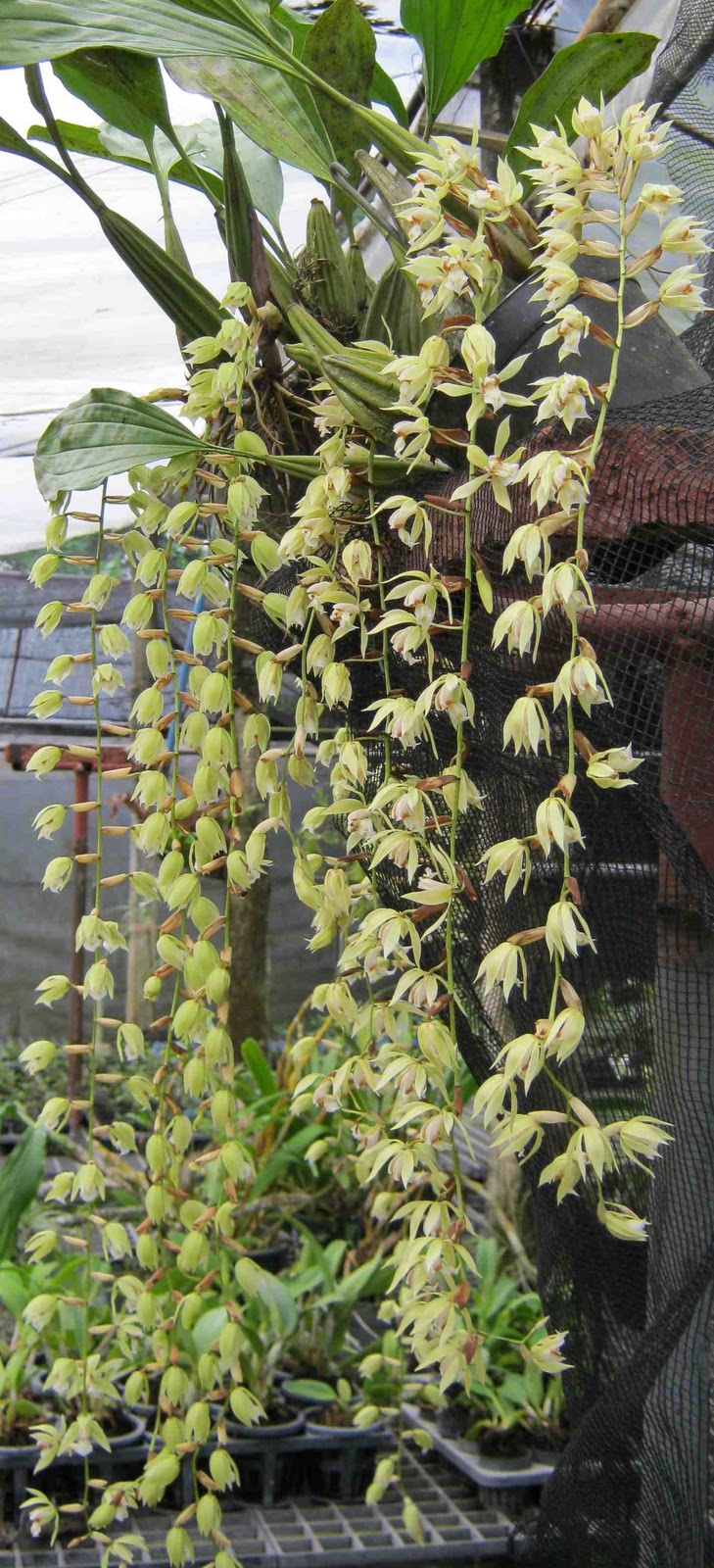
And to cap my very hectic month, the coelegynye rochussennii were all abloom.  Here is a shot of the flowering clump and a close up of the spike as well.


These native orchids from Mindanao were bought many years ago in a regional garden show without flowers.

The seller practically twisted my arm to buy them as I was then in no mood to buy.  He said that they are called "rosary orchids" since the flower spikes are long and a clump can send plenty of spikes.

I was glad I allowed myself to be "convinced" as these plants adapted very well to life in the farm.  It helped that my farm is a bit cool too which I found out to be one of the requirements for this orchid to flower.

Grown under a single net with coconut husk for growing medium, the plants receive nothing extra but for the twice monthly fertilization.  They were also watered when the growing media started to become dry.

For many years now, without fail, these plants would send out this long yellow flower spikes at this time of the year.

Whew,  what a full October it has been!


Sunday, November 7, 2010

Green Buildings and Vertical Gardens

One of the more visible trends in gardening that seem to have been gaining ground is the green building and its component part, the vertical garden.

It is not surprising that this trend will find more acceptance in more economically advanced nations as the push of continuous industrialization and expansion of commercial and residential construction in these countries will mean less and less space for people to use for plants and for gardening.

There is also greater appreciation in such countries of the role that plants can play in the need to urgently reduce global warming compared to the less developed ones where subsistence remains the main issue.

A stereotype building is made up of two basic exterior parts, the roof and the walls.  The green building, which in its entirety is all covered up with living plants (except for the windows and the doors), is likewise made up of a planted roof and walls cladded with living plants.

While the completely green building is still a rarity in the Philippines, a partially green one is easier to come by:  either small scale vertical gardens or planted roofs.

Various plants that may be hanged
One of the oldest concept of the vertical garden is the use of the vertical component of space for growing plants.

While gardening is mostly carried out horizontally as planting is land-based, the vertical element gets to be forgotten or not at all utilized.  This is the case of concrete walls and fences that have been left bare though the base have been planted adequately.

With the use of trellises installed on walls, vines or creeping plants potted and hanged on beams, or the use of epiphytic plants that are attached to walls, more and more vertical spaces get to be  filled up with greens.

Then of course there are plants that are grown on the ground and can literally attach themselves to walls as in the case of the creeping fig.

Such initial approaches have been expanded to the point that now, whole walls, even whole buildings have been enveloped with living plants.

While we have yet to see such examples in the Philippines, in other more advanced countries, these green buildings are becoming quite common.


A planted roof is a class altogether separate from the vertical garden.  However, the development of vertical gardens, is so closely intertwined with that of roof plantings.  In a lot of situations, it is first the roof and then afterwards the walls that are planted.

Of course, in a building, the roof would be considered the easiest to install with plants, especially if it flat or has little slope.  The only consideration will be the capability of the structure to carry the additional weight of the plant materials and the growing media or soil.


A modern home with a lawn installed on its roof.  Note the roofs of neighboring homes
Modern buildings with its generally flat concrete roofs are ideal candidates for such applications.  For as long as the building can bear the additional load, the planting scheme can be quite straightforward and is made up mainly of grass.

The major issue for such an installation in addition to the additional weight is the difficulty of correcting leak problems should this eventually crop up.

In very tall buildings, the logistics of bringing up the materials will also have to be planned real well.
From the roofs, the development has progressed to the walls.  These days,
covering the walls with living plants has been made easier with the use of technology.

There are systems that are now available that will allow the installation of a vertical garden ranging in size from a few square feet in area to several thousand square feet.

These come with planters, frames as well as watering systems.  They can even be fixed or portable as in the case of planted dividers which have rollers already installed at the base of each unit for ease of mobility.

These developments have made it possible to conveniently grow plants  that will cover a vertical wall like the one on the right.

These could entail a major investment in terms of the non-plant materials that will have to be used.  It would require considerable expertise on the part of the planner and the installer.

On the other hand, not only do such systems help the environment by lowering temperature, reducing noise and removing pollutants from the air, they also improve the quality of life of people as they can transform an otherwise drab area into a living work of art.


A fully planted wall instead of a plain concrete fence


Setting up walls such as the one shown above is made possible by putting together a series of planters and holders that interlock with each other.

These ingenious contraptions come in several forms but all provide enough planting media and drainage for plants to have a solid base for their roots and from which these roots can derive the plants' nutrient and water requirements.

In a sense, such walls are made up of tens, hundreds, or even thousands of small pots strung together to cover a vertical expanse and which when planted with selected plants that are suitable for the given environment would transform the space from dull to green.

Still another form of vertical garden is achieved not through the use of small pots or planters but through the use of a fabric-like material that may be planted and draped over a surface like a carpet of green.

This approach is used when a wall of grass is desired as shown in the background of the picture below.  On the more extreme side, it can be used to drape a three-dimensional figure with living plants as the dolphin in the foreground illustrates.  With this method, topiaries which could take a long time to develop become redundant as the same effect may be obtained at a fraction of the time.  To top it all, different plants may be combined to create a figure with different colors and texture, something that will be extremely difficult to do with a traditional topiary.


The "fabric" is made up of at least two sheets of heavy-duty synthetic cloth that sandwich a medium that can hold the roots of the plants as well as retain substantial amounts of water. The composite fabric is then stretched over a frame or a framework. As shown below, this fabric is slit at the areas where plants will be inserted.


Regardless of the approach, the finished "garden" is always a sight to behold!  Beautiful and at the same time earth-friendly.


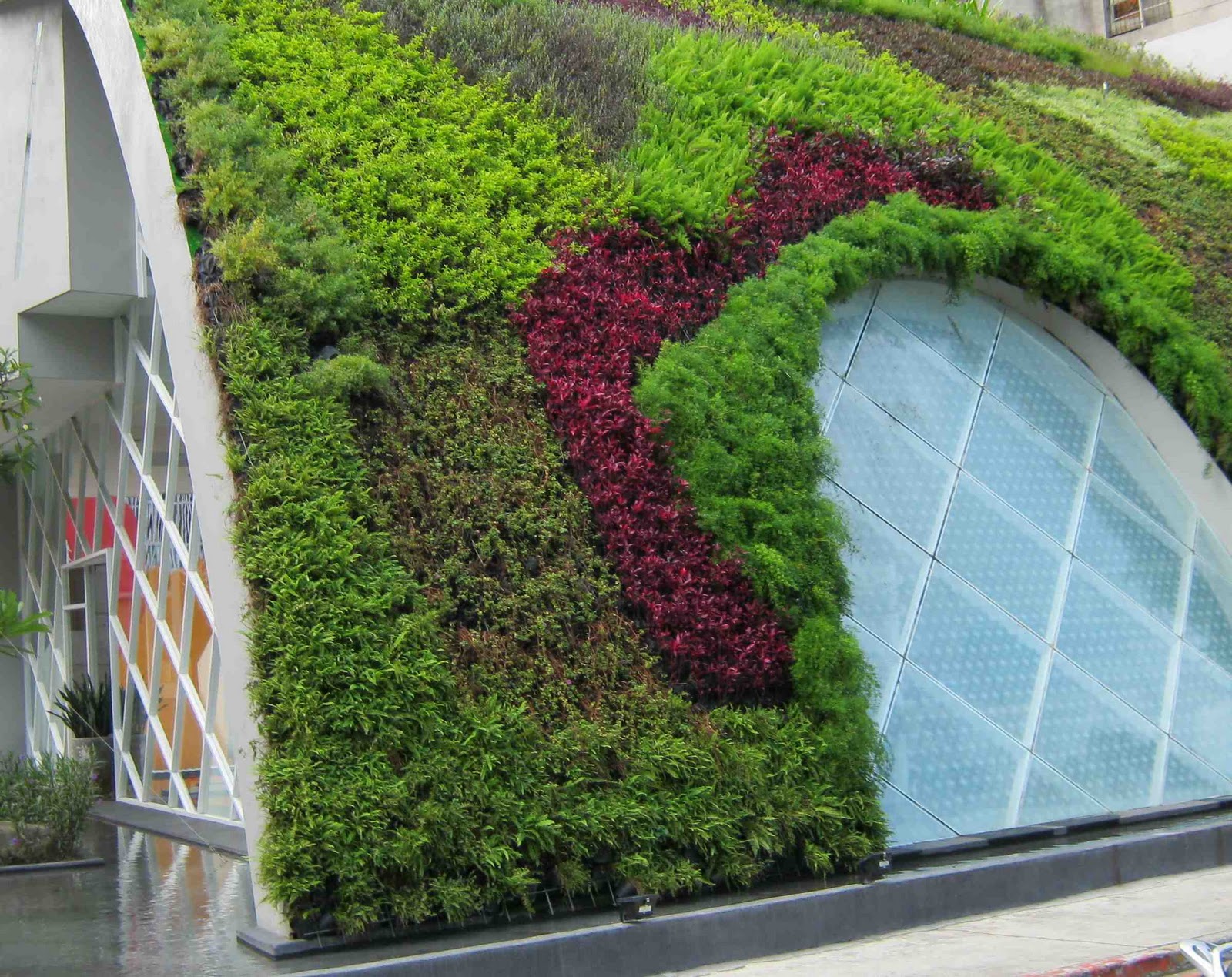
Green building completely planted except for the glass windows and doors.

Saturday, October 30, 2010

Taiwan's Gems: Phalaenopsis Orchids, Part 4 (Final)


A very close friend who is very much into the horticulture scene in the Philippines and who has been keenly following my posts have asked me why I am posting plants that are grown in other countries as well as gardens  that I see in my travels abroad.

He wondered whether I was stepping out of bounds as far as the intent of my blog is concerned, what with the title, Philippine Gardener.

So, before I complete my series on Taiwan phalaenopsis, let me share what I explained to my concerned friend.  Just in case someone who would read this blog would be similarly inclined as my friend, this is the reasons why one would find posts on plants grown or gardens in countries outside the Philippines (in addition of course to those that are local grown):

1.  Horticulture just like most things nowadays is becoming more and more global.  If gardening in our country is to remain vibrant, it must remain economically viable and that means being able to hold our own as against other countries that are recognized as leaders in world horticulture.

2.  Beauty knows no national boundaries and benefits from diversity.  By always testing the limits, learning from others outside one's comfort zone, integrating new experiences into how one sees the world, one's aesthetic appreciation is deepened.

3.  While others may be lost permanently as they pursue a journey outside of what they were born with, those who are able to integrate the new lessons learned from outside to what they started out with become even more appreciative of their origin.

And please excuse the philosophical ramblings.

So here are the last of the phalaenopsis photographs.  These will focus on two interesting colors:  yellows and reds.


The Yellow Phalaenopsis


Yellows come in the palest to very brightest shade, just like the pinks.  They may range in size from the smallest to slightly bigger than medium size.  

They may also have other color pigments thrown in for interest as in the case of the pink blush that is present in the petals and sepals of this flower, in addition of course to the dark pink lip also called red lip.


Typical medium sized white or pink but this time in yellow

Light yellow color with partly orange lip


Yellow with pink spots and red-lip


Clear, rich yellow-green with dark maroon red and white lip


Yellow base with red spots and pink lips


Yellow with big red spots
Red Phalaenopsis

While there were a number of beautiful reds that I have seen and photographed, unfortunately, only these two turned out well.  This is not to say that these two are not worth much.  On the contrary, both are very beautiful. 

Just like some of the other colors that are still being developed, the flower sizes, shape and color may further be improved.  Also, the number of flowers per spike can stand a lot of improvement especially if this will be compared to the more developed whites and pinks.

Dazzing deep red color


Visually a red but it seems like a yellow with full red spotting to look almost red


Wednesday, October 27, 2010

Taiwan Flora Expo 2010, Update on the Philippine Exhibit, Finally Complete


My cousin Jerome who took my place to help the designer's team in executing the Philippine exhibit just arrived early this morning (October 28).  The exhibit has been completed finally and he generously shared the photos he took two days ago.
Jerome with Expo promotions

He, together with the rest of the remaining filipinos working on the exhibit, left Taipei a little past midnight and arrived in Manila just before dawn.  

Tomorrow, a new set of designers would be leaving to work on the indoor exhibit competition.

For now, just enjoy some of the shots of the Philippine Exhibit that Jerome shared with me this morning.

The centerpiece of the exhibit is the bell tower so let us take time to look at it from several angles.

The back of the bell tower as seen inside the exhibit


Front view of the bell tower


The bell tower as you enter the main exhibit entrance


The pictures whose captions are highlighted in green were taken by Enteng, our interpreter who took them October 28.  They were shot a little farther from the subject as compared to the ones with yellow highlighted captions, and thus afforded us a wider view of the individual windows as well as the bell tower.  Hopefully, the addition will increase our appreciation of the work done by the team lead by Baby Spowart, her son Mark, designers Kelvin Manubay, Tony Padilla, CV Lazaro, Tata Montilla, Cyrus, Jerome and myself plus a whole lot of others who worked on the exhibit that the photos captured.
A shot that gives a wider view of the belltower

Entrance to the exhibit


The individual window exhibits were created with slight differences from each other.  The six windows below show a wealth of props that were sourced in Manila. They also feature a number of garden ideas as well as the variations a tropical garden may take.

Underground River, Palawan window


Palawan Underground River window, long shot
Boracay Island window


Boracay window, long shot
Banawe Rice Terraces window

Banawe Rice Terraces window, long shot


Mayon Volcano, Bicol Region window

Mayon Volcano window, long shot


Chocolate Hills, Bohol window


Chocolate Hills window, long shot

Vigan, Ilocos Region window


Vigan window, long shot
Due to quarantine regulations, most of the plant materials were sourced from Taipei, with only the bromeliads flown in from the Philippines.  However, since the weather in Taipei is similar to certain parts of our country, one can expect to see the same plants in most filipino gardens.

This exhibit should help showcase the creativity of filipino garden designers as they create side by side with their counterparts from different parts of the world given the constraints under which they have to work.  

Given the millions of visitors that are expected to visit the expo in the next six months, hopefully, it could create considerable interest in the beauty that our  country can offer so that these visitors would want to personally visit and experience the Philippines.